former journalists discuss a profession in crisis

Posts Tagged ‘journalism’

March Celebrated Past But Didn’t Commit To Future

In Blog on August 30, 2013 at 2:30 pm

What happens when you compress all the news coverage of Black History Month into one week, and put it on steroids?  This week’s commemoration of the 50th anniversary of the March on Washington for Jobs and Freedom.

Don’t get me wrong. It is absolutely fitting to mark this event, and to pay homage to the heroes of the Civil Rights Movement.  Dr. Martin Luther King’s “I Have a Dream” speech ought to be remembered. We should honor the years of struggle that African-Americans endured to galvanize a nation.  Their nonviolent protests were met with beatings, imprisonment and death, and those horrendous events were broadcast across the nation.  Television journalism helped inform the conscience of a nation.

But what was lacking in the commemoration was the acknowledgment that the strides in racial equality also demanded political power.  As dramatic and moving as the civil rights protests were, the prospects for legislative reform 50 years ago seemed dim, at least until the Southern Democrats’ hold on the Senate was broken.

Ignoring that fact meant that this week’s events were more about emotion than strategy and leadership. The reading and viewing public got a big dose of memories, leavened with cogent analysis of the continuing legacy of racism. It was in large part, about sharing memories. NPR’s “The Race Card Project,” offered us an intriguing glimpse into the feelings of average Americans about black-white relations.

Watching the broadcast coverage of the event, one was struck by the tens of thousands of people who gathered on a rain-soaked day, the speeches, and the songs.

But here’s one concern about all that coverage. The March was framed as the one event that changed the course of history, prompting the passage of landmark civil rights and voting rights laws.

No one wants to diminish the March’s impact. It was crucial to the advance of civil rights. But the media ill serves the civil rights movement and history when it implies that speeches and marches alone change history. King, and his colleagues sowed the seeds for reform, as did the hundreds of thousands of civil rights activists throughout the country. And civil rights leaders were acutely aware of the obstacles that stood in their way in Congress, and used the media as a vital tool to overcome some of those obstacles.

Read the rest of this entry »

The Press Let the Pope Off Easy

In Blog on July 29, 2013 at 12:13 am

I am a Catholic, but even I thought that the coverage of Pope Francis’ visit to Brazil could have used a bit more hard-nosed journalism.

World Youth Day, occurring biennially, brings hundreds of thousands of young Catholics from all over the world to celebrate their faith and meet with their pope.  The fact that this event occurred in Brazil this year, early in the tenure of this new Latin American leader of Catholicism, gave the pope just the positive exposure that the Vatican PR machine must have hoped for.  Reporters like to cover events that are unpredictable, that evoke emotions, and that can be told with much drama.  In all aspects, the pope delivered. It didn’t hurt that the pope was visiting a country that had lost hundreds of thousands of Catholics, many to evangelical Christianity, adding a bit of political intrigue to the event.

There was nothing wrong about the chronicling of the pope’s dramatic  visit to Rio’s slums, and his eagerness to reach out to the poorest of the poor, or the millions flocking to hear him say Mass on the Copacabana beach.  

And the pope deserved praise for preaching social justice to a country that has been wracked by corruption and income inequality.  The pope is considered one of the world’s moral leaders, and his message of concern for the struggling and homeless, has been a powerful symbol of a new direction for the Church.  But that should not make him immune from scrutiny.

Many reporters seemed reluctant to criticize his decision to reject a pope-mobile and to open the windows of his Fiat sedan as it was mobbed by a crowd as crazy as a bunch of girls at a Justin Bieber concert. Indeed, the Associated Press enthused that this reckless conduct was a powerful symbol of recapturing “the dynamism” of the Church and going out into the streets. To its credit, The Wall Street Journal raised concerns about the pope’s decision to flaunt security protocols. But generally, the media was ready to blame everyone but the pope for the security problems, and focused more on the pope’s lack of fear than his heedlessness.

Again it isn’t that all aspects of the pope’s trip, including its roughly $50 million cost to the Brazilian government, weren’t covered.  It is just that they were asides. And protests from Brazilians about the costs certainly didn’t dominate coverage. For example, CBS’s Dean Reynolds did do a morning news report that included footage of the protests, but that story didn’t appear to make it to the nightly newscast:

Read the rest of this entry »

How The Post Failed The Public on Wal-Mart

In Blog on July 18, 2013 at 8:00 am

Washington, D.C. probably is home to more think tanks and economists than any other city in America. So you would think The Washington Post, still the city’s leading newspaper, might have turned to some of them to shed a little light on a major local controversy.

The D.C. City Council recently passed the Large Retailer Accountability Act, or the “living wage bill.”  It would require large retailers to pay a minimum wage of $12.50 an hour.  In reaction to the passage of the bill, Wal-Mart has said it will withdraw plans to develop three stores in the District, and reconsider its plans for three other stores already under construction. As I write this, no one knows whether Washington Mayor Vincent Gray will veto the bill.  It doesn’t appear that the council has the votes to override a veto.

I am not complaining about The Post’s two editorials opposed to the living wage bill.  The paper has a right to take a position on this issue, albeit one that was heavily biased in Wal-Mart’s favor.

What does bother me is the quality of the paper’s overall coverage. As this controversy has played out, The Post has failed to provide comprehensive ongoing reporting on the issue, or to give its readers consistently solid explanatory journalism that provides facts and context, and challenges assumptions.

Instead, The Post’s coverage has been scatter-shot.  Some of its best analysis seemed to be left to the paper’s blogs, which tend to be more commentary than straight news, and while very informative, lack the authoritative voice of news stories. Blogs, too, are not always published in the print editions of the paper.  That means that the people most affected by the Wal-Mart decision, those in underdeveloped neighborhoods waiting for a Wal-Mart bounce, might not have access to all the information about the controversy.

At the very least, The Post should have explained what the living wage bill does in some detail, not just once, when the bill was introduced, but for each significant story on the controversy.  A Post story in March included facts about the living wage bill that were significant and deserved repetition.  The living wage bill applies only to large retailers who have not negotiated wages through collective bargaining agreements. And the $12.50, as I understand it, is actually $11.75 if benefits already provided by the employer are factored in. That distinction appears to have been lost in most of the subsequent news coverage of the law.

But The Post should have done much, much more.  It could have reached out to the city’s urban policy experts and economists, and given the community coverage that:

Read the rest of this entry »

Out of the News Honored for Best Research About Journalism at SPJ Sigma Delta Chi Awards

In Blog on June 24, 2013 at 9:00 am

The main ballroom of the National Press Club in Washington was an extraordinary place last Friday night, June 21, as the Society of Professional Journalists honored 84 reporters and editors in print, broadcast and online for excellence in journalism. 

I was thrilled to be among this distinguished group of 84.  Out of the News was cited for excellence in media research.  The message of event is similar to the message of my book: Despite enormous economic challenges, a lot of good journalism is being done throughout the country, and is serving democracy well.

I can’t do justice to all the winners, but here are a few examples of stellar reporting, thinking and writing that won the coveted awards.

 As Connecticut’s major newspaper, The Hartford Courant had the solemn and sad duty of trying to make sense of the massacre of children at the Sandy Hook Elementary School in Newton last December.  In a series of editorials, it did so.  I especially admired “We Have to Change,”  with its opening admonition to readers, “Stay angry. Remember how you felt this weekend,” and its rejection of the political platitude that now is not the time to discuss gun control.  “We disagree; now is exactly the time,” the editorial states.  “If the brutal execution of 20 children and six educators doesn’t spur meaningful action, we are not worthy of their memory.”

David Fanning, who for decades has helmed PBS’s documentary series Frontline, had another winner in Big Sky, Big Money – by far the clearest and most definitive documentary I’ve seen that details the impact of relaxed campaign spending rules on democracy.  Set in 2012 in Montana during the closely contested Senate race between Sen. Jon Tester and challenger Rep. Denny Rehberg, the documentary probes how out-of-state money changed the political landscape in that state, to the consternation of Democrats and Republicans alike. 

The documentary also demonstrates the growing collaboration among nonprofit media.  PBS made the film in cooperation with the online investigative journalism site, ProPublica and American Public Media’s Marketplace.

 Another honor went to Jim Dwyer for a column on the unnecessary death of a 12-year-old boy from sepsis, an often lethal blood infection that, in this case, resulted from a cut.  A big man in a light suit, Dwyer doesn’t look the epitome of Manhattan cool.  Perhaps that reflects the humanity that imbues his metro columns for The New York Times.  Dwyer deftly describes various facets of his city and its residents, telling beautifully written stories that often show the consequences of bureaucratic indifference or incompetence.  His winning column detailed how Rory Staunton’s (age 12) symptoms were recognized too late both by his pediatrician and then by physicians at a New York hospital.  Their inattention led to his death.  The column paints a real-life portrait of an exceptional and thriving young man, while giving us an almost clinical report of the missed symptoms that robbed him of his life.  What is masterful is Dwyer’s attention to detail and his ability to let the facts make his case. There is outrage here, but it is controlled. 

Read the rest of this entry »

Reporting It Right, The First Time

In Blog on May 7, 2013 at 9:00 am

The Boston Marathon bombings reminded us of the perils of real-time reporting.  Live tweeting, streaming news coverage and instant punditry all seemed to conspire together to confound and confuse.

In this age of nearly instant communication, there were instant and inaccurate reports, about the number of dead, the progress of the investigation, and the suspects.  The New York Post did everything but declare two teens in the crowd to be the perpetrators, circling their faces in red, on a cover photo titled “Bag Men.”   Other media outlets breathlessly told us that a Saudi man might be sought in the case, also wrong. We were even told that a suspect was arrested when no arrest had been made.

Washington Post media critic Paul Farhi isn’t bothered by fast-breaking news containing mistakes.  He wrote that in a media environment where events happen, and are reported, in real time, errors are inevitable, and don’t matter as much as they used to.   Farhi cites Mark Jurkowitz, associate director for the Project for Excellence in Journalism, who observed that technology greatly speeds up the correction of initial misinformation, and thus errors matter less.

That seems like a rather weak defense.  If news outlets want to be taken seriously, the major value they bring to the table is that they report verified facts, not unverified assertions or speculation.  If CNN isn’t better than the Twitterverse, why does it exist?  If the chances of my receiving credible fact-based information aren’t improved if I pick up a newspaper rather than search for reports in the blogosphere, why should I bother with any mainstream news outlet?  Indeed, Farhi ends his column with another observation from Jurkowitz, who notes that mistakes damage the credibility of the news media as a whole, even when the public fails to distinguish media outlets that report the facts from those that are more lax.

The New York Times’ David Carr got it right when he noted that accuracy is something that the American public ought to expect, and get, from its news media.  If journalists merely regurgitate what they hear, anyone can do their job.

And despite our obsession with knowing everything in real time, we also look to mainstream media outlets for validation of what we learned, and – to some extent – the kind of power and beauty that words can impart to terrible events.  The day after the bombings, I picked up The New York Times, and came close to tears when I read the first sentence of its main story.  Listen to its cadence, the somber measured tone of the words, the restraint.

Two powerful bombs exploded near the finish line of the Boston Marathon on Monday afternoon, killing three people, including an eight-year-old child, and injuring more than 100, as one of this city’s most cherished rites of spring was transformed from a scene of cheers and sweaty triumph to one of screams and carnage.

Journalism is not just about reporting what happened.  A journalist bears witness to terrible events, and in the bearing witness, brings some order into chaos.

Read the rest of this entry »

Out of the News Wins the Society of Professional Journalists’ Sigma Delta Chi Award

In Blog on April 23, 2013 at 2:26 pm

I’m pleased to announce that I have been honored by the Society of Professional Journalists (SPJ) with a 2012 Sigma Delta Chi Award for excellence in journalism in the category of Research.

sigma-delta-chi-award-3

As Both a Scientist and a Mom, Yvonne Brill Deserved a Better Obit

In Blog on April 9, 2013 at 9:00 am

There’s been a lot of fuss, and deservedly so, about The New York Times’ obituary of eminent rocket scientist and inventor Yvonne Brill.  The problem was instead of leading with a description of her significant scientific achievements, the obit writer began by letting readers know she made “a mean beef stroganoff” and was “the world’s best mom.”

In fairness, the obit writer got to the important stuff about her scientific career in the second paragraph, and The Times’ headline also helped communicate that this was a woman of significant accomplishment.

The Times quickly saw the error of its ways, and revised its opening paragraph.

And to tell you the truth, I am less upset about the sexism in the obit than the sheer lack of quality in the writing.  No one deserves a trite obit, particularly if your career has been both impressive, and in some ways, heroic.

Journalism is about letting subjects  – even deceased ones — speak for themselves.  I am not going to cast any feminist darts at the author of the piece (as that has already been covered in many other publications).  I can well imagine how it may have happened.  On deadline, you are asked to write an obit.  You contact the son, who talks a lot about his mother as he knows her.  You’ve got a lot of background info, and some good quotes.  You pull more off the internet.  You’re trying to write something a bit arresting.  The trouble is, you haven’t talked to enough people, and you haven’t let the subject speak to you, though the material is right in front of you.

If the real Yvonne Brill treasured her stroganoff over her rocket propulsion patent, so be it.  But anyone who continued to push for more recognition for women scientists while battling breast cancer, likely cared deeply about her work, something that she devoted her life to while still raising a family.

Only after giving us information that made the obit muddled and trivial – such as how she met her husband and that neither of them cared for square dancing, did the obit give us a telling detail about what she did the last week of her life, a detail which, if I had been writing this obit is what I would have led with.

This is what I would have written:

Read the rest of this entry »

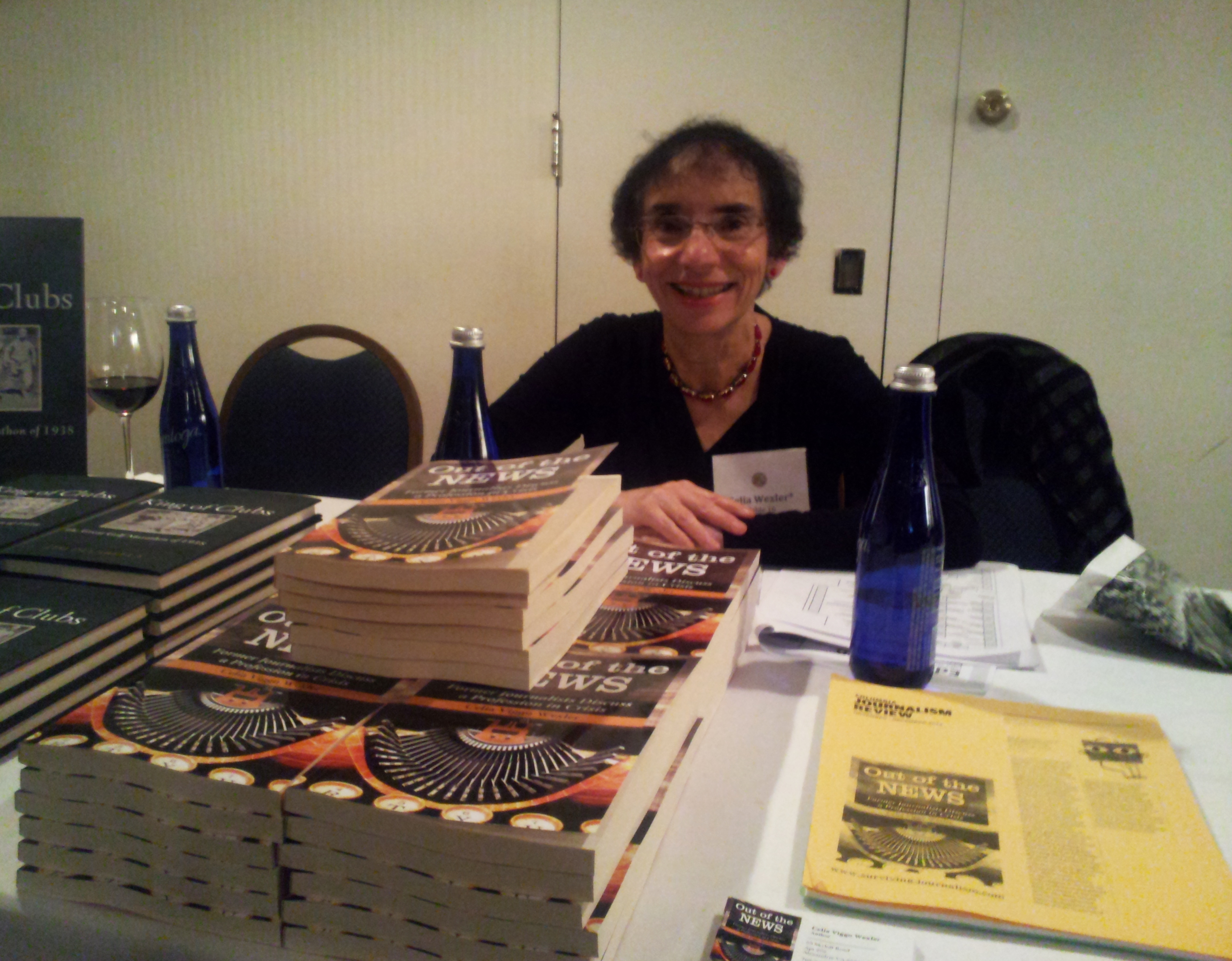
Out of the News At The National Press Club Book Fair

In Blog on November 23, 2012 at 9:00 am

Ever since I began writing a book, my dream was to sell it at the National Press Club book fair.  And as my publication date drew closer I even checked with the Press Club to make sure that my book would be published by the submission deadline.  Getting to the fair required a lot of procedural and other hurdles that impaired both my digestion and my sleep.  But finally, a few weeks ago, I received the official acceptance.

I then obsessed about my appearance for the great event.  I bought a vintage red choker, a new top, and earrings from a boutique in Alexandria.  One other mini-disaster threatened. Two hours before the fair, I got a call from the organizers informing me that my books had not yet arrived.  My husband offered to deliver books we had already purchased and dashed off to our home in Alexandria to get them.  Ten minutes later, I got a second call with the good news that the books showed up in the fair’s very last shipment.

All the strategizing, anxiety and planning was worth it. The fair is a terrific event, drawing many big-name authors and hundreds of visitors.  Those authors lucky enough to be selected celebrate their good fortune at a private reception before the event begins.  I wouldn’t stand in line to get a glimpse of a movie star, or snag an autograph from my favorite musician, but I was dazzled to be in the same room as accomplished writers such as Hedrick Smith and David Corn.  I also was pretty dazzled by Georgetown Cupcake’s contribution to the event!

The second, unexpected, highlight of the evening was being interviewed for a short segment for C-SPAN’s BookTV.  I love BookTV.  I think I am the equivalent of a football enthusiast who watches any game.   Any book talk draws me in, no matter what the subject.  On weekend nights, I will fall asleep listening to BookTV interviews.

Read the rest of this entry »

The National Press Club Book Fair And Authors’ Night

In Blog on November 19, 2012 at 1:40 pm

I was honored to have Out of The News featured at the 2012 National Press Club Book Fair!  A post on the experience to come soon but here are some pictures for now.


more pictures here!

Read the rest of this entry »

THE BLOG: Dear Aaron, about your “woman problem”…

In Blog on September 2, 2012 at 7:40 pm

Dear Aaron,

I have been entertained by The Newsroom these past weeks.  I could overlook the fact that The Newsroom did not, in fact, resemble any newsroom I had ever worked in.  But then again, my experience had been in print journalism, not broadcast.  So perhaps broadcast newsrooms have more paper hearts for Valentine’s Day than a typical day care center, and people in broadcast share their life secrets and dating history spontaneously and almost continuously.

I grew somewhat fond of the plot lines, and could tolerate the endless references to Don Quixote, when I would have preferred H.L. Mencken. I could even suspend disbelief and imagine a news environment entirely devoid of cynicism and black humor.

But what I can’t forgive is the mess you make of your women journalists.

I realize that young women bloggers were on to this sexism long before I was.  My daughter opened my eyes, and referred me to posts on The Hairpin like this one.

But now that I’ve been sensitized, I have gotten more and more angry.

Sexism in journalism has had a long and storied history. It still is not entirely dead, so how you portray women in the news matters.  We haven’t achieved that level of professional security where we can just laugh it off.

Early in my own career, I was turned down for a reporting job in a very small town in upstate New York because the editor said he “wanted to replace a man with a man.”  By then, there were laws in place that would have permitted me to sue that editor for sex discrimination.  But what would have that gotten me in the long run?  Damages, maybe, but also a reputation in the news business for being “difficult.”  So I didn’t sue.

When I interviewed women journalists for my book, Out of the News, I realized how prevalent the gender discrimination has been.  While some benefited by being mentored by women who were pioneers in the field, others still bore the brunt of unequal treatment with men into the 1980s, 1990s and even the 21st century.   Beverley Lumpkin is a good example of a talented reporter who faced sexism her entire career.  Although she’d done extensive investigative work for congressional oversight committees and ABC’s 20/20 newsmagazine, Lumpkin was stuck on stakeouts when she took a job with ABC’s Washington news bureau, waiting to shout a question to newsmakers as they emerged from their homes or offices.  It was nearly a year before she got substantive news assignments.  Her reportorial skill and expertise covering the Department of Justice never earned her an on-air reporting position on the prime-time network news shows, and after more than 20 years of service, when the bureau was cutting costs, she was one of the “older” women journalists who were let go.

Just last month, a survey revealed that about 75 percent of the print stories about the 2012 presidential campaign have been written by men, during an election when the voting bloc most dear to the candidates of both parties is the “women’s” vote.

Read the rest of this entry »