former journalists discuss a profession in crisis

Archive for the ‘Blog’ Category

Journalists Should Stop and Do the Math on Minimum Wage

In Blog on February 13, 2013 at 1:31 pm

In last Saturday’s Washington Post, Matt Miller of the Center for American Progress authored a very thoughtful oped proposing that we raise the minimum wage, which currently is so low that it forces people who work full time to live in poverty.  Miller argues that increasing the minimum wage is a much simpler solution to the problems of the poor than the raft of federal programs out there to help alleviate poverty.  Plus, if the minimum wage were increased, thousands of workers would have the discretionary income to increase their consumer spending, improving the economy.

So what does Miller’s proposal have to do with journalism? In my mind, quite a bit.  Here’s the problem. Most journalists haven’t been paid by the hour since they were teens babysitting or mowing lawns.  When they report about the working poor, they fail to do the math, and since they thought $9 an hour was pretty good when they were 15, the reality of how little the minimum wage is and how inadequate it is to support a family is lost on them, and their readers and viewers.

So let’s do the math. A full-time worker earning the federal hourly minimum wage of $7.25 earns a princely $15,080 a year.  Let’s boost that figure up a bit, to the hourly wage of $10.  Annually, that amounts to $20,800.  Could you live on that?  Would that be enough to pay for food, clothing, and shelter?  (Let’s assume that your employer gives you health benefits, which isn’t too likely.)  When you live this close to the bone, losing a dollar bill or a metro card that drops out of your pocket is a disaster.  You can’t afford any sick time.  A vacation is a faraway dream. No restaurants with tablecloths.  No books.  No movies.  There is no margin for error.  God help you if you thought you could raise a child or two, or live in a decent neighborhood.

So here’s my plea, all you journalists out there.  Whenever you are doing a story about a minimum wage worker, do the math, and translate that hourly wage into what most of us are lucky to earn, an annual salary.  It will not change national policy, but maybe it will give the rest of us just a little more empathy for the burdens of the working poor.

Washington Post Ombudsman Lowers the Bar for “Great” Journalism

In Blog on February 7, 2013 at 3:10 pm

I often agree with Washington Post ombudsman Patrick Pexton. But not this week.

He begins his column with a question: “You know what makes The Post great, on its best days?”

The answer? “Reporters reporting.”

Uh, right. Presumably, however, reporters also report for The Post on its worst days and on all the mediocre days in between. So perhaps Pexton had in mind some extraordinary examples of great reporting.

No such luck. “It is reporters” he points out, who sit “through hours of a city or county council session or a congressional hearing,” to get the quote or fact that prompts a surprising news story. “It is reporters” who wait until (egads!) “after midnight” to witness a controversial zoning decision vote. “It is reporters” with “ringing ears” no less, who make phone calls to talk to sources to get the information they need to write a story they were assigned to that morning. “It is reporters” who have to go to “bloody crime scenes” and encounter “people who are upset, stressed and crying.”

This is what supposedly “separates” the work of Post reporters from the “…thin reporting that passes for journalism in media land.”

I agree there’s a lot of “thin reporting” out there. But the work Pexton describes is so basic to plain vanilla journalism that it should not be cast as heroic. It should be the floor for the profession, not the ceiling.

Pexton could as easily have written, “It is dentists” who “bravely attack tooth decay, put their hands into dirty mouths, and who have to extract dead, bloody teeth from people who are upset and stressed.”

Read the rest of this entry »

CNN and The New York Times: How Committed To Good Journalism?

In Blog on January 19, 2013 at 10:37 pm

I don’t know which is sadder – the fact that CNN decided to outsource much of its investigative reporting last May, or that the event largely escaped notice until The Daily Show publicized it last week. CNN is such a shadow of itself, I’m not sure how big an audience there is for its investigative reports, or what real impact they have on the world. Nevertheless, anytime investigative reporters lose full-time jobs, that’s not good news.


Being outdone by a fictional news show isn’t great either.

And while The New York Times isn’t laying off any environmental reporters, the fact that the paper announced this month that it would disband its environment desk also raised concerns about the paper’s continuing commitment to covering the environment. As I wrote in my blog for the Union of Concerned Scientists, I can’t say I find The Times’ explanation for axing the specialized desk of reporters and editors very convincing.

Out of the News on C-SPAN

In Blog on January 16, 2013 at 9:00 am

celiaonbooktv

I was interviewed at the 2012 National Press Club Fair by C-SPAN’s Book TV and the interview is up on the C-SPAN website!

Last of the ‘Lifers’? Milwaukee Magazine Reviews Out of the News UPDATED

In Blog on January 3, 2013 at 9:00 am

Updated to add!  The review and the book also got a mention yesterday from Jim Romenesko in a post on journalists leaving the newsroom.

A great review of Out of the News yesterday by Milwaukee Magazine’s Erik Gunn. He was even inspired to find out what the lives of some of his former colleagues have been like since they left the newsroom:

The simultaneous explosion and implosion of media may be especially dispiriting for the would-be lifers: If journalism is all you ever wanted to do, what happens when the craft changes so much it seems unrecognizable, or the ranks of working journalists become so decimated that you have no choice but to explore something new?

I pondered that question while perusing Out of the News: Former Journalists Discuss a Profession in Crisis (McFarland & Co., 203 pp.), by Celia Viggo Wexler. Wexler, a newspaper reporter turned lobbyist for the Union of Concerned Scientists, produced the book from probing interviews with 11 journalists who found themselves forced by conscience or circumstance to leave the profession. (Disclosure: Nearly 30 years ago in Rochester, N.Y., Wexler and I knew each other while working for competing newspapers.)

Probably her most prominent subject is David Simon, the former Baltimore Sun reporter and creator of acclaimed TV shows including The Wire, which devoted one season to the struggles inside an urban newspaper. But the other 10, virtually all from the top ranks of media organizations, have stories just as compelling.

Read the rest of this entry »

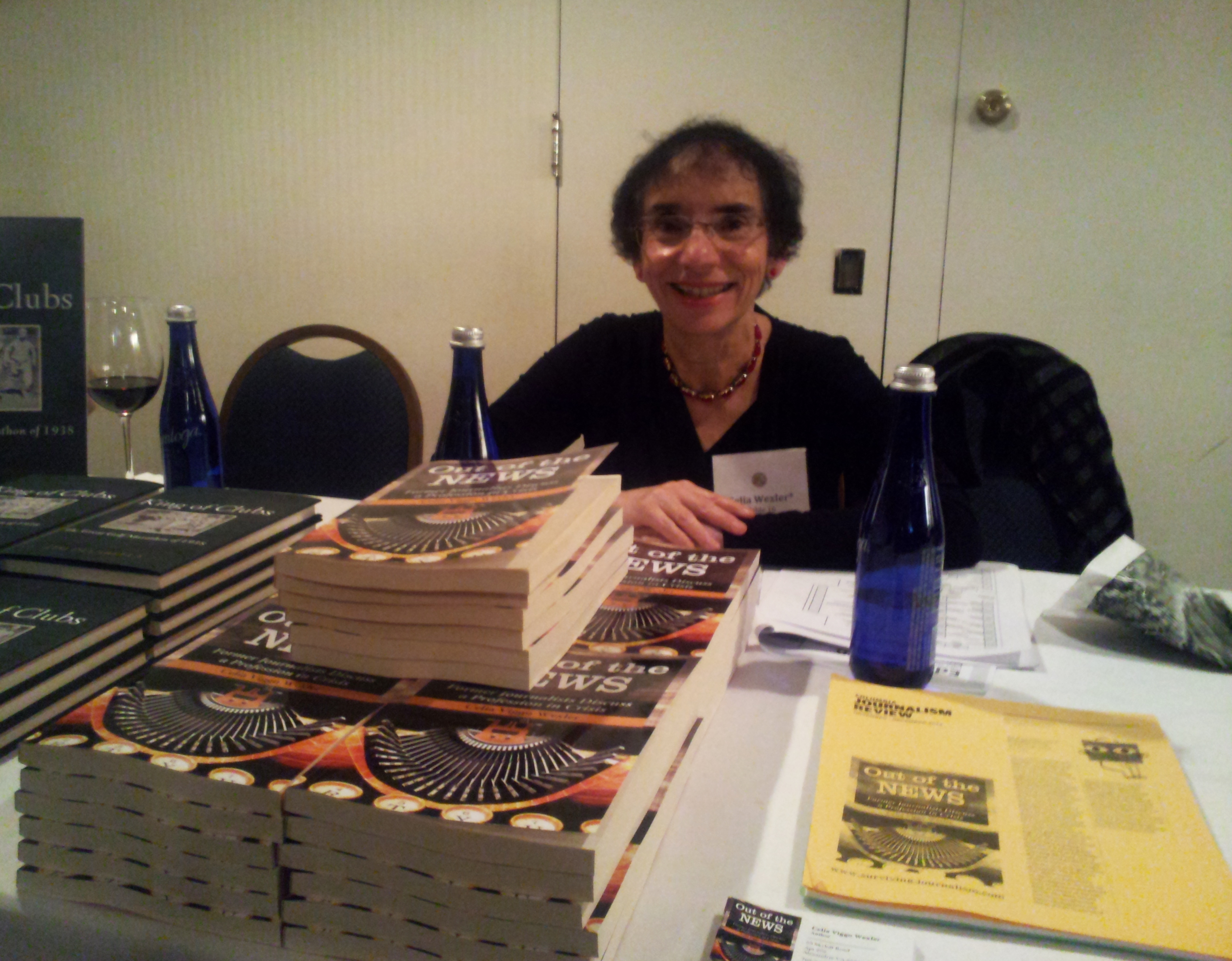
Out of the News At The National Press Club Book Fair

In Blog on November 23, 2012 at 9:00 am

Ever since I began writing a book, my dream was to sell it at the National Press Club book fair.  And as my publication date drew closer I even checked with the Press Club to make sure that my book would be published by the submission deadline.  Getting to the fair required a lot of procedural and other hurdles that impaired both my digestion and my sleep.  But finally, a few weeks ago, I received the official acceptance.

I then obsessed about my appearance for the great event.  I bought a vintage red choker, a new top, and earrings from a boutique in Alexandria.  One other mini-disaster threatened. Two hours before the fair, I got a call from the organizers informing me that my books had not yet arrived.  My husband offered to deliver books we had already purchased and dashed off to our home in Alexandria to get them.  Ten minutes later, I got a second call with the good news that the books showed up in the fair’s very last shipment.

All the strategizing, anxiety and planning was worth it. The fair is a terrific event, drawing many big-name authors and hundreds of visitors.  Those authors lucky enough to be selected celebrate their good fortune at a private reception before the event begins.  I wouldn’t stand in line to get a glimpse of a movie star, or snag an autograph from my favorite musician, but I was dazzled to be in the same room as accomplished writers such as Hedrick Smith and David Corn.  I also was pretty dazzled by Georgetown Cupcake’s contribution to the event!

The second, unexpected, highlight of the evening was being interviewed for a short segment for C-SPAN’s BookTV.  I love BookTV.  I think I am the equivalent of a football enthusiast who watches any game.   Any book talk draws me in, no matter what the subject.  On weekend nights, I will fall asleep listening to BookTV interviews.

Read the rest of this entry »

The National Press Club Book Fair And Authors’ Night

In Blog on November 19, 2012 at 1:40 pm

I was honored to have Out of The News featured at the 2012 National Press Club Book Fair!  A post on the experience to come soon but here are some pictures for now.


more pictures here!

Read the rest of this entry »

Tough New Public Editor Challenges Top Brass at The Times

In Blog on October 29, 2012 at 2:27 pm

Margaret Sullivan and I were both cub reporters in Buffalo.  And even then she was considered a strong, good reporter who couldn’t be bullied.  It’s clear that she hasn’t lost that toughness.

Sullivan, who rose to be editor and vice president of The Buffalo News, this year joined The New York Times as its public editor. Perhaps because she knows what it’s like to be in the executive suite, Sullivan seems to have had no qualms about giving her new bosses some advice about a prickly personnel issue.

As the newspaper’s public editor, Sullivan’s mission, according to The Times, is to “write about The Times’ journalism and the people who produce it,” and to serve as a “liaison to the paper’s readers.”  To ensure that the public editor is independent, unlike every other journalist on the planet, Sullivan has been promised a four-year tenure.  So at least in theory, she can poke a stick at the big bosses in public, and not get the sack.  But there are thousands of other ways that you can feel the wrath of upper management even when your tenure is secure.  It will be interesting if, at the end of two years on the job, she exercises her option to re-up for another two years.

Only four months into her new job, Sulllivan now is writing frank comments about a very messy controversy brewing at The Times, which concerns the man the Gray Lady had selected to be its new president and chief executive officer.

Mark Thompson, The Times’ CEO in waiting, is in the vortex of an emerging scandal in his home country.  He had been a high-ranking executive at the BBC when BBC investigative reporters were about ready to do a story alleging that a beloved BBC entertainer, Jimmy Savile, who died last fall, had been a sexual predator during the 1970s and 1980s.  (What better gig for a predator than a familiar TV face who visited lots of children’s hospitals?)  But the BBC killed the investigative piece, and, even worse, aired a couple of smarmy Christmas tributes to Savile.

Saville, according to news accounts, had been the target of police investigations in the past, but they all had been dropped.  The BBC journalists had their story squelched, but a competitor network subsequently broadcast its own story about the scandal. After the story broke, more than 200 victims came forward to allege abuse.

Thompson has told a British parliamentary committee looking into the Savile matter that he didn’t kill the story and that he hadn’t known about the Savile investigation.

Thompson’s initial denial that he hadn’t heard anything about the flap was then followed by a clarification that yes, he had been approached at a party by a BBC journalist who mentioned the program.  He told The Times that he then asked BBC news executives about the report, and was told it had been canceled for “journalistic” reasons.

The Times has been reporting on the story, often citing aggressive follow-ups by British journalists.  Just today, for example, The Times noted that the killing of the BBC’s story had been reported in the media several times, making Thompson’s lack of interest in the story and why it was spiked, a bit more difficult to swallow.

Read the rest of this entry »

THE BLOG: Dear Aaron, about your “woman problem”…

In Blog on September 2, 2012 at 7:40 pm

Dear Aaron,

I have been entertained by The Newsroom these past weeks.  I could overlook the fact that The Newsroom did not, in fact, resemble any newsroom I had ever worked in.  But then again, my experience had been in print journalism, not broadcast.  So perhaps broadcast newsrooms have more paper hearts for Valentine’s Day than a typical day care center, and people in broadcast share their life secrets and dating history spontaneously and almost continuously.

I grew somewhat fond of the plot lines, and could tolerate the endless references to Don Quixote, when I would have preferred H.L. Mencken. I could even suspend disbelief and imagine a news environment entirely devoid of cynicism and black humor.

But what I can’t forgive is the mess you make of your women journalists.

I realize that young women bloggers were on to this sexism long before I was.  My daughter opened my eyes, and referred me to posts on The Hairpin like this one.

But now that I’ve been sensitized, I have gotten more and more angry.

Sexism in journalism has had a long and storied history. It still is not entirely dead, so how you portray women in the news matters.  We haven’t achieved that level of professional security where we can just laugh it off.

Early in my own career, I was turned down for a reporting job in a very small town in upstate New York because the editor said he “wanted to replace a man with a man.”  By then, there were laws in place that would have permitted me to sue that editor for sex discrimination.  But what would have that gotten me in the long run?  Damages, maybe, but also a reputation in the news business for being “difficult.”  So I didn’t sue.

When I interviewed women journalists for my book, Out of the News, I realized how prevalent the gender discrimination has been.  While some benefited by being mentored by women who were pioneers in the field, others still bore the brunt of unequal treatment with men into the 1980s, 1990s and even the 21st century.   Beverley Lumpkin is a good example of a talented reporter who faced sexism her entire career.  Although she’d done extensive investigative work for congressional oversight committees and ABC’s 20/20 newsmagazine, Lumpkin was stuck on stakeouts when she took a job with ABC’s Washington news bureau, waiting to shout a question to newsmakers as they emerged from their homes or offices.  It was nearly a year before she got substantive news assignments.  Her reportorial skill and expertise covering the Department of Justice never earned her an on-air reporting position on the prime-time network news shows, and after more than 20 years of service, when the bureau was cutting costs, she was one of the “older” women journalists who were let go.

Just last month, a survey revealed that about 75 percent of the print stories about the 2012 presidential campaign have been written by men, during an election when the voting bloc most dear to the candidates of both parties is the “women’s” vote.

Read the rest of this entry »

Introduction to Out of the News

In Blog on August 8, 2012 at 9:00 am

Some of you may have seen an early version of this excerpt from the Introduction to Out of the News.  It first appeared a year ago, on the Columbia Journalism Review website:

On September 17, 1982, the Courier-Express unit of the Buffalo Newspaper Guild voted to do something no other media outlet in the U.S. had done or would do: it voted to turn down an offer from Rupert Murdoch’s News America Publishing Company to buy the failing Buffalo morning daily. The vote meant that Buffalo would be left with one newspaper, The Buffalo News. And it meant that the daily paper’s 1,100 employees would lose their jobs.

But to the union, being bought by Murdoch was about more than saving their livelihoods. It was about the future of journalism. I was the reporter assigned to cover that vote and the end of my own newspaper. I will never forget the emotionally charged night meeting, or the words of Richard Roth, a CourierExpress reporter and Guild international vice president. Roth was a legend at the Courier. Big and tough—he’d once threatened a meek city editor with physical violence if he ever changed his copy again—Roth was one of two reporters inside the prison yard in 1971 when Attica prison erupted in a bloody riot which resulted in the deaths of 29 prisoners and 10 hostages. At the tender age of 22, Roth was nominated for a Pulitzer for his work covering the riot and its bloody aftermath.

Murdoch demanded substantial staff cuts in the newsroom, and wanted the power to decide who would go and who would stay. Giving Murdoch that kind of leverage seemed wrong to the vast majority of the 250 guild members who crowded into the Statler Hotel that night to vote on Murdoch’s final offer. The guild wanted the rule of “last hired, first fired” to prevail.

It seems almost quaint now, but Courier reporters believed that experience should count for something in a newsroom, that there was a value and a dignity to working for a newspaper and learning a beat and a community. They also believed that reporters should have the freedom to write the truth, without fear of reprisal. Journalists, Roth said, needed “to be protected from ruthless publishers who may not want unfavorable things written about them or their friends.”

But there was something more leading up to the vote. Courier journalists, myself included, had researched Murdoch’s U.S. papers at the time and were not impressed. We did not want the CourierExpress, whose past editors had included Mark Twain, to be transformed into a sleazy tabloid. We wanted the daily that had existed for well over 100 years to be remembered with dignity.

Read the rest of this entry »